

Why Abacus Kids Remember More—But It’s Not Eidetic Memory
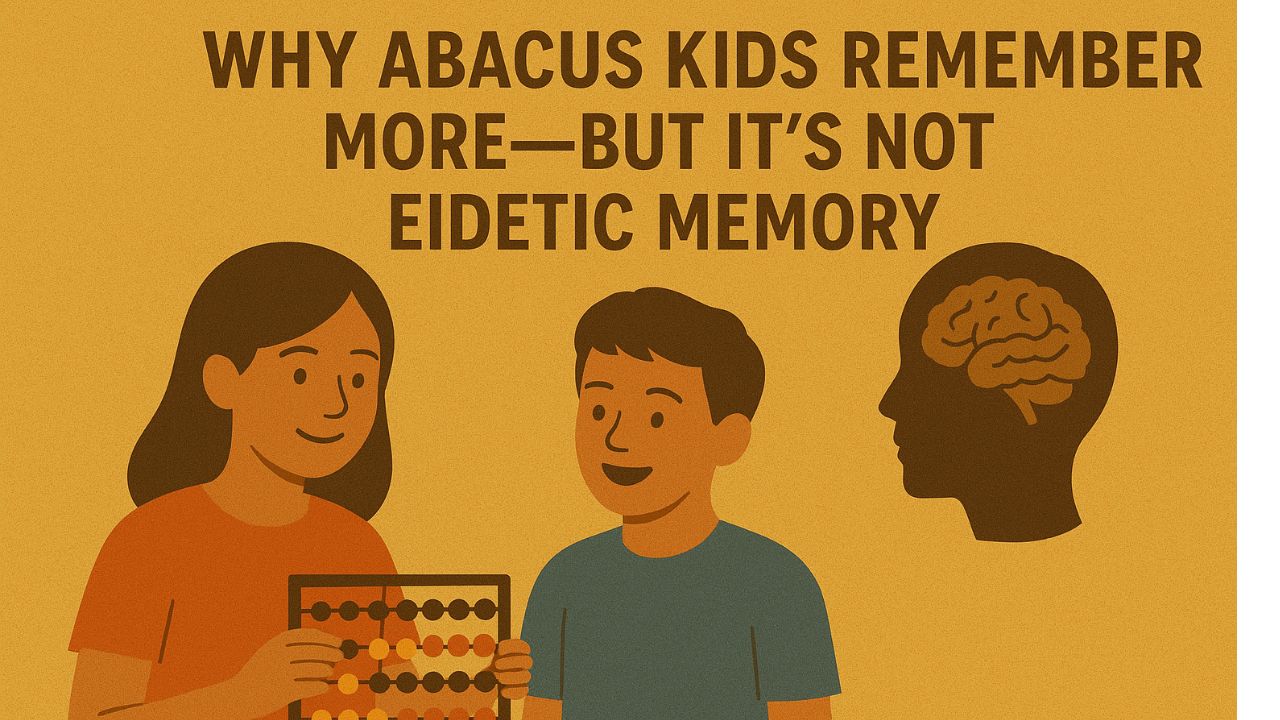
Across living rooms and after-school centers worldwide, children sit with rows of wooden beads, flicking them back and forth in a blur of motion.
Parents often notice something remarkable: after a few months of abacus training, their children can hear a long string of numbers once and repeat it perfectly. Some can even calculate faster than a calculator.
It’s natural to wonder, “Is my child developing a photographic or eidetic memory?”
The short answer: abacus practice builds a striking, highly trained working-memory skill—but it is not the same as true eidetic memory.
Let’s unpack what’s really happening inside an abacus-trained brain, how that differs from the rare phenomenon of eidetic memory, and what parents can genuinely expect.
1. The Spark Behind the Question: When Numbers Seem to Stick Like Glue
A well-trained abacus student might listen to a 20-digit number just once and then rattle it back instantly—or add and subtract those digits in their head while doing so.
To family members, it can look like a supernatural feat of recall. Teachers often remark that these students also appear sharper in class, following multi-step instructions or remembering details from a lesson with ease.
What you’re seeing is real cognitive growth—but it isn’t a photographic snapshot of reality. It’s a learned mental-imagery technique built around a very specific tool.
2. What Scientists Mean by “Eidetic Memory”
The popular term photographic memory suggests an ability to take a mental picture of a page or scene and replay it with perfect detail at any time.
Research, however, finds no convincing evidence that adults can do this.
What occasionally appears in children is eidetic memory: the ability to hold a vivid mental image of something just viewed, almost like seeing it projected on an internal screen, for maybe 30 to 60 seconds. Even then, the details fade quickly, and the child may misremember colors or positions. By adolescence, this ability usually disappears.
So eidetic memory is:
- Short-lived
- Largely visual
- Rare and not under voluntary control
That’s a very different process from what happens during abacus training.
3. The Mental Abacus: A Workout for Visuospatial Working Memory
Modern abacus instruction, especially the widely practiced Abacus-Based Mental Calculation (AMC) method, teaches students to form a vivid mental picture of an abacus and “move” the beads in their minds while doing arithmetic.
To succeed, a child must:
- Visualize a precise three-dimensional image.
- Hold multiple digits in working memory.
- Update that mental picture rapidly as operations proceed.
This is an intense workout for the visuospatial working-memory system—the brain’s “mental scratchpad” for visual and spatial information.
A 2011 Journal of Neuroscience study led by Qinghua Han found that children with two years of AMC training showed stronger activation in frontal and parietal brain areas and performed better on visuospatial memory tasks than untrained peers.
Other research in Frontiers in Psychology (2020) confirms that these gains are reliable for arithmetic and related visuospatial tasks.
4. Why Abacus Skills Can Look Like Eidetic Memory
When an advanced student instantly repeats a long string of numbers, it resembles photographic recall.
But here’s what’s really happening:
They’re encoding those numbers into a familiar mental structure—the abacus.
Instead of remembering raw digits, they remember bead patterns and their movements. The mental image is highly organized, much like how a chess master remembers the layout of a chessboard after a glance: not as isolated squares, but as meaningful chunks.
This is structured, trained memory, not an involuntary snapshot.
5. Domain-Specific, Not All-Purpose
Scientists call this domain-specific transfer.
Abacus training improves skills that overlap with the training itself—number memory, mental rotation, sequential processing.
But when researchers test unrelated abilities—remembering faces, random pictures, or entire pages of text—abacus experts do not show the kind of all-purpose recall that true eidetic memory would imply.
For example, a 2017 meta-analysis on AMC found strong benefits for calculation speed and visuospatial working memory but little evidence of broad “far transfer” to unrelated cognitive tasks.
6. Real Benefits Parents Can Celebrate
Abacus training still offers a long list of scientifically backed advantages:
- Enhanced Working Memory
Children learn to juggle several pieces of information simultaneously and update them in real time. - Sharper Concentration
Keeping a moving mental image of beads requires sustained focus and quick attention shifts. - Better Number Sense and Math Confidence
The tactile and visual nature of the abacus turns abstract numbers into something concrete and intuitive. - Visualization Skills Useful Beyond Math
From geometry to art, the ability to picture and manipulate images in the mind carries wide benefits.
7. Setting Healthy Expectations
Parents sometimes enroll children hoping for a “mind like a camera.”
The reality is more practical—and just as exciting when understood clearly:
- Abacus training will strengthen numeric memory, mental calculation, and visuospatial thinking.
- It will not create permanent photographic recall or the rare, short-lived eidetic images occasionally observed in young children.
Knowing this upfront prevents disappointment and keeps the focus on genuine growth.
8. Supporting Your Child’s Cognitive Growth
- Value Consistency Over Speed
Daily short practice sessions build deeper skills than occasional marathons. - Make Numbers Part of Daily Life
Let your child calculate grocery totals or mentally split a restaurant bill. - Encourage Broad Learning
Pair abacus practice with reading, storytelling, and sports to nurture a well-rounded brain. - Introduce Proven Memory Strategies
If you want to boost general memory, explore methods like the method of loci (memory palace) or spaced repetition. These help long-term recall more than any promise of photographic memory.
9. Talking to Curious Friends and Family
When someone asks, “Does abacus give your child an eidetic memory?” you can answer confidently:
“It trains an amazing mental-math skill and strengthens working memory. That’s different from true eidetic memory, which is rare and fleeting.”
This balanced reply celebrates your child’s achievement without fueling myths.
10. The Big Picture
The abacus is a timeless learning tool that merges ancient tradition with modern neuroscience.
It helps children see numbers, move them in their mind, and build cognitive muscles that last a lifetime.
What it doesn’t do is turn a child into a human camera—and that’s perfectly fine.
By understanding the difference between abacus-enhanced working memory and true eidetic recall, parents can support their children with realistic expectations and genuine enthusiasm.
Celebrate the authentic wins: sharper focus, quicker calculations, and a joyful confidence with numbers.
Those are superpowers worth far more than a mythical photographic memory.