

Culture, Not DNA: Why Spelling Bees Reward Practice
Introduction — a myth worth correcting
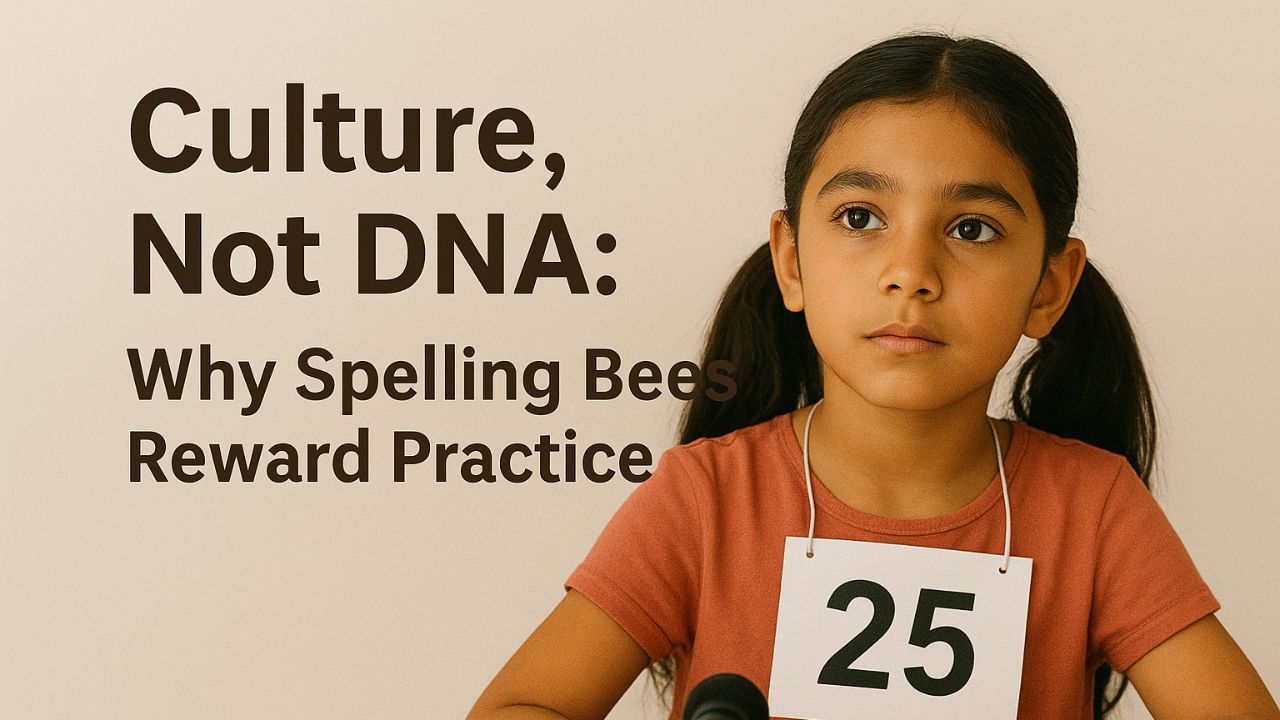
If you’ve caught highlights from recent Scripps National Spelling Bees, one fact may have jumped out: children from Indian immigrant backgrounds win at remarkably high rates. That pattern has led to lots of speculation — including a persistent but misleading idea that success is somehow genetic. The reality is sharper, more interesting, and far more useful for parents: spelling-bee success is best explained by culture, community infrastructure, and deliberate training. It’s about the environments families build, not DNA.
This article explains the cultural science behind that success. I’ll show the social forces at work, how preparation actually happens, what trade-offs families face, and—most importantly—how NRI parents anywhere can adopt smart, child-friendly practices to help kids thrive.
A quick snapshot: the pattern, not the presumption
Between the late 1990s and the 2020s, Indian-origin contestants captured a very large share of national titles — roughly three out of every four in many recent windows. That concentration is striking because Indian-origin families make up a small fraction of the U.S. population. But concentrated success only looks mysterious if you assume genetics. If you look instead for systems and culture, the pattern becomes logical: a community with concentrated resources, motivation, and organizational smarts can produce outsized results in a narrow, rule-bound contest.
Why ‘not DNA’ is the right starting point
There are three reasons the genetic explanation fails as an account:
- Timing doesn’t match heredity. The community’s dominance emerged recently and accelerated quickly — after an early breakthrough in the 1980s and a cultural tipping point around the late 1990s. Cultural shifts and network effects can move fast; genetic change cannot.
- Representation and social proof matter. When children see role models who look like them onstage and in media, participation grows. The 1999 documentary Spellbound and later media visibility offered clear, relatable examples: success felt attainable, so more families invested time and energy.
- Training explains transferable skills. Spelling-bee skill isn’t raw memory alone — it’s a set of teachable techniques (root analysis, language families, deduction strategies) that can be learned, practiced, and passed from one student to another.
Saying “culture, not DNA” is not dismissing talent; it’s pointing to the mechanisms that produce talent at scale.
Culture and migration: a fertile soil
The story begins with migration patterns. Immigration policy changes in the mid-20th century shifted flows toward highly educated, English-educated professionals from India. Many immigrant parents arrived with strong educational credentials and a clear focus on upward mobility. That matters because:
- Children grew up in households where education was framed as central to stability and identity.
- Parents often had the means, background, or networks to value structured practice and regular feedback.
- English proficiency and familiarity with academic norms made early exposure to vocabulary, reading, and logic easier.
When families treat educational achievement as a primary pathway to security, they naturally invest time and resources in competencies — including spelling, vocabulary, and pattern-based thinking.
Community infrastructure: building a pipeline
Culture alone isn’t enough; it needs an ecosystem. The community built a “feeder system” — local clubs, community-run bees, coaching networks, and national-level events — that normalizes practice and performance. That system:
- Lowers the barrier to entry by keeping costs and logistics manageable.
- Creates repeated opportunities to compete and learn from failure.
- Produces mentors (former contestants) who pass down techniques and rehearsal routines.
Think of it like youth sports: the same basic activities (practice, mock contests, coaching) repeated at scale produce visible talent. Once a community organizes around a pursuit, participation and standards rise together.
The mechanics of preparation: what champions actually learn
Contrary to popular belief, top spellers are not simply memorizing endless lists. Their preparation emphasizes:
- Etymology and language families. Greek, Latin, Sanskrit loanwords, Germanic stems — understanding roots helps decode unfamiliar words.
- Pattern recognition. Spellers learn how suffixes, prefixes, and letter combinations recur across languages.
- Phonetic rules and exceptions. Mastery of predictable patterns reduces reliance on brute memory.
- Mock bees and performance practice. Spelling under pressure is a skill; simulated contests teach calm, pacing, and recovery from mistakes.
- Metacognitive strategies. Students learn how to ask the right questions about a word (origin, language of derivation, pronunciation nuances) that narrow down possible spellings.
These are teachable skills. They also transfer to broader literacy and critical thinking — which is why many families see spelling training as more than “winning a bee.”
Social side: peers, mentors, and motivation
Preparation rarely happens in isolation. Peer groups, parent-organized study circles, and former-champion coaches create a social texture that sustains effort. Children enjoy the camaraderie of shared goals; parents benefit from pooled knowledge about curriculum, mock contests, and resources. The social payoff helps months of practice feel normal rather than extraordinary.
Trade-offs and ethical cautions
Any model that produces exceptional results also creates potential pitfalls:
- Pressure and well-being. Intense focus can contribute to stress, burnout, or anxious perfectionism. Parents must watch for loss of joy, sleep disruption, or anxiety.
- Opportunity cost. Time invested in specialized training reduces time for sports, arts, or free play. Diversity of experiences matters for long-term wellbeing.
- Perverse incentives. If a child’s value becomes tied only to outcomes, motivation may become extrinsic and fragile.
NRI parents should adopt the useful elements of the model (structured practice, community) while deliberately protecting childhood. Balance is both ethical and strategic: children who enjoy learning sustain interest longer and perform better.
Practical lessons for NRI parents
If you’re an NRI parent wondering whether to encourage spelling practice, here are concrete, balanced steps:
- Start playful and curious. Read aloud together. Play word games. Let the child experience language as fun before making it “serious training.”
- Teach strategies, not just lists. Focus early on roots, affixes, and language families. That builds transferable skills for reading and writing.
- Short, consistent practice beats marathon sessions. Fifteen to thirty minutes a day, several days a week, is more effective than infrequent long drills.
- Use community resources. Look for local clubs, online groups, or community-organized bees. The social element accelerates growth.
- Simulate the contest. Regular mock bees teach performance skills: speaking clearly, asking for definitions, and maintaining composure.
- Watch the stress signals. Joy, sleep, appetite, and peer relationships are barometers. If the process becomes all pain and no play, it’s time to reassess.
- Keep pathways open. Spelling skills feed vocabulary, literacy, and thinking. Emphasize these benefits rather than a single trophy.
- Model a growth mindset. Praise strategies and effort: “You broke that word into roots — great thinking,” rather than “You’re brilliant.”
How families overseas can replicate the good, avoid the harm
NRI parents in Europe or other countries can apply the model without reproducing unhealthy extremes:
- Form or join small study pods. Three to five families can share coaching duties and mock contests.
- Invite experienced coaches for workshops. A single local workshop can jumpstart a club’s methods.
- Use reputable online resources. Language-root lists, recorded mock bees, and online mentors connect families across geographies.
- Keep cultural context in mind. Local school schedules, exam systems, and extracurricular pressures differ — adapt practice intensity to your child’s broader life.
Conclusion — a useful reframing
The story of Indian-origin spelling champions is not a tale of inherited brilliance but a practical case study in how culture, institutions, and strategy create success. For NRI parents, that should be empowering: the ingredients are visible and replicable. But replication should be humane. The best approach borrows the scaffolding — steady practice, community, strategic learning — while preserving play, variety, and mental health.
If you want your child to enjoy language, become a confident performer, and reap lifelong literacy gains, focus first on curiosity and sustainable routines. Trophies may follow. And even if they don’t, the real win is a child who loves words and knows how to learn.