

Abacus vs. Photographic Memory: What Parents Should Really Expect
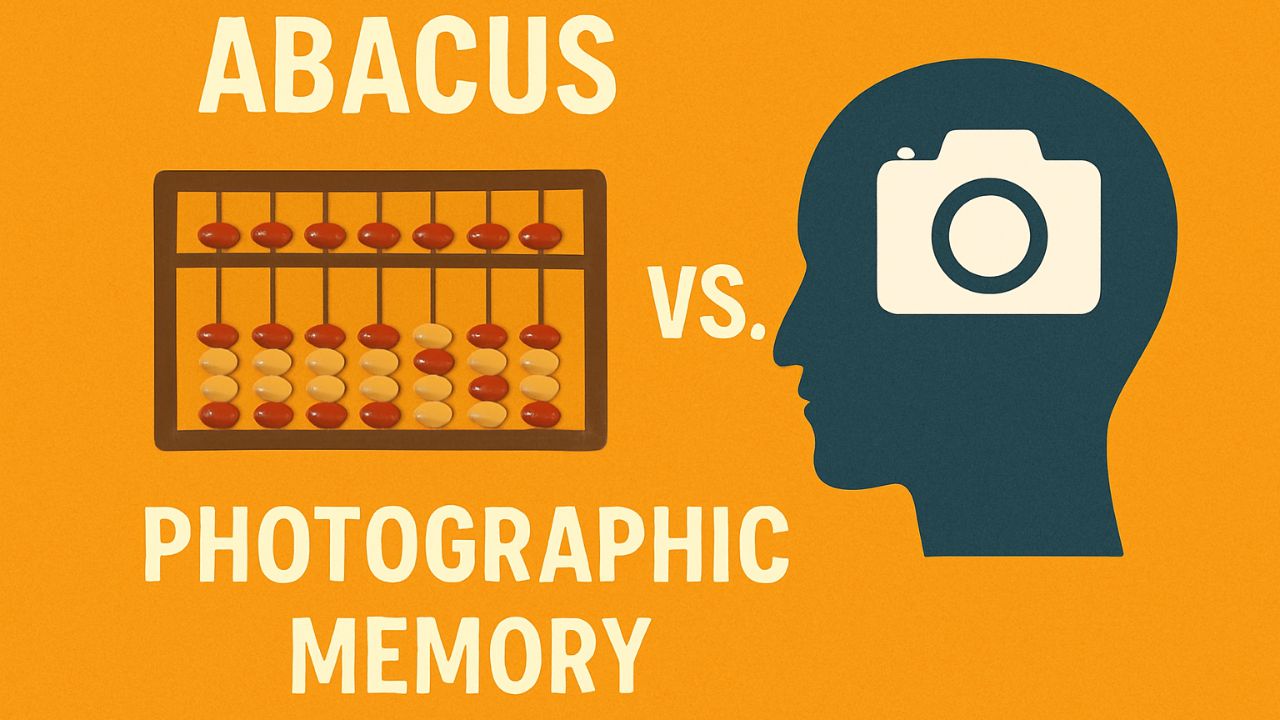
When parents sign up their children for abacus classes, they often hear impressive promises: lightning-fast calculation, sharper concentration, maybe even a “photographic memory.”
The image is enticing—a child who can look at a page of numbers once and recite every digit, or who never forgets a lesson or a face.
But is that really what abacus training delivers?
The short answer: abacus practice does build remarkable memory and mental-math skills, but it does not create photographic or eidetic memory, nor does it produce the rare ability called Highly Superior Autobiographical Memory (HSAM).
Here’s what science—and years of classroom experience—tell us parents can realistically expect.
1. Untangling the Buzzwords: Photographic, Eidetic, and HSAM
Photographic memory is a popular phrase for the idea of perfect recall of images or text after just one glance. Despite the myth’s persistence in pop culture, researchers have never verified a case of true photographic memory in adults.
What some people mean instead is eidetic memory—a vivid mental picture that lingers for a short time, mostly seen in children and usually fading within a minute or two. Even then, the “snapshot” is far from permanent.
Highly Superior Autobiographical Memory (HSAM), sometimes called hyperthymesia, is something else entirely. People with HSAM can recall astonishing details of their own life—dates, conversations, even what they ate for lunch years ago—without trying. It’s extraordinarily rare, linked to unusual patterns in brain networks that support autobiographical memory.
None of these abilities have been shown to arise from training programs. They’re either unproven (photographic), fleeting (eidetic), or extremely rare and likely genetic (HSAM).
2. What Abacus Training Really Teaches
The modern “mental abacus” method asks children to picture a virtual abacus in their minds and move its beads to perform calculations.
To do this, a student must:
- Visualize a detailed mental image of the abacus.
- Hold multiple numbers in working memory.
- Manipulate that image in sequence—sometimes at high speed.
This is demanding work for the visuospatial working-memory system, the brain network that lets us picture objects, track movement, and organize information in space.
Regular practice strengthens this system much like sports training strengthens specific muscle groups.
Dozens of studies—from Japan to India to Europe—show that children who train with the abacus outperform peers on tasks that require visual–spatial working memory and mental arithmetic.
For example, a 2011 study in Journal of Neuroscience reported that children with two years of abacus-based mental calculation (AMC) training showed stronger activation in the frontal and parietal lobes and performed better on visuospatial memory tasks than untrained classmates.
3. Why Abacus Expertise Can Look Like Photographic Memory
Watch an advanced mental-abacus student recite a 20-digit number after hearing it once and it feels magical. But here’s what’s really happening:
They’re not recalling a random string of digits as a raw picture.
They’re encoding those digits into the structured visual schema of the abacus. Each cluster of beads represents place values and groups of numbers, so what they “see” and recall is a familiar mental object, not an unprocessed snapshot.
This is a classic example of mnemonic strategy—powerful, but learned and specialized. Remove the abacus framework, and the same student won’t necessarily recall a complex painting or a page of prose after a single glance.
4. Domain-Specific, Not All-Purpose
Cognitive scientists describe this as domain-specific transfer.
Abacus training improves skills that overlap directly with the training tasks—number memory, mental rotation, and sequential visuospatial reasoning.
But when researchers test unrelated abilities—like remembering faces, random word lists, or autobiographical events—results are mixed or negligible.
A 2020 review in Frontiers in Psychology analyzed dozens of studies and concluded that the strongest, most consistent benefits of abacus training occur in numerical cognition and related visuospatial memory, not in general photographic recall or intelligence.
5. Setting Healthy Expectations
For parents, this evidence points to a clear message:
- Yes: Abacus practice can give your child extraordinary confidence with numbers, faster mental math, and better concentration.
- No: It will not grant a supernatural “camera mind” or the lifelong autobiographical recall seen in HSAM.
That’s not a limitation—it’s an honest understanding of what the tool is designed to do.
6. The Real Benefits You Can Celebrate
- Stronger Working Memory
Abacus learners juggle multiple digits while updating their mental image, which strengthens the brain’s “mental notepad.” This helps not just in math but also in tasks like following multi-step instructions or organizing schoolwork. - Improved Attention and Focus
Moving those mental beads demands sustained attention. Teachers often report that abacus students stay on task longer and shift between problems more smoothly. - Number Sense and Confidence
By making numbers tangible, the abacus helps children truly grasp place value and arithmetic relationships, turning abstract math into something they can “touch” in their mind. - Visualization Skills
Visualization is a powerful tool across subjects—from geometry to creative writing. Abacus training provides daily practice.
7. Helping Your Child Maximize These Gains
- Encourage Regular Practice, Not Just Speed
Consistency matters more than racing through calculations. - Connect Math to Everyday Life
Let children use their mental abacus to total grocery costs or split a restaurant bill. - Celebrate Process, Not Just Results
Praise focus and effort. Building mental images is hard work and worth recognition. - Support Broad Learning
Pair abacus lessons with reading, storytelling, sports, and arts to foster well-rounded development.
8. If You’re Interested in Memory Beyond Numbers
If you want to help your child build a better general memory—not photographic, but genuinely stronger—you can introduce proven techniques:
- Method of Loci (Memory Palace)
Teach them to associate facts with vivid mental locations. - Spaced Repetition
Review material over gradually increasing intervals. - Meaningful Connections
Encourage making stories or images around facts or vocabulary.
These strategies are well documented to enhance long-term recall and complement abacus training beautifully.
9. Talking Points for Curious Parents
When other parents ask whether abacus gives kids a photographic memory, you can answer with confidence:
“It trains an amazing mental-math skill and sharpens working memory. That’s different from photographic memory, which science hasn’t really proven to exist in adults.”
This balanced view keeps expectations realistic and keeps the focus on genuine, lasting benefits.
10. Final Word
The abacus is a centuries-old tool with thoroughly modern relevance. It turns numbers into something a child can see and move in the mind’s eye, building discipline, confidence, and cognitive agility.
What it does not do is turn a child into a human camera or an autobiographical savant—and that’s perfectly fine.
By appreciating abacus training for what it truly offers—a powerful workout for the brain’s working-memory and attention systems—parents can support their children with enthusiasm and honesty.
Celebrate the real victories: the spark of confidence when a tricky calculation clicks, the calm focus during a math test, the joy of mastering a timeless skill.
Those are achievements worth far more than the elusive, mythical promise of photographic memory.