


Beyond Numbers: How Abacus Builds Focus, Memory, and Confidence
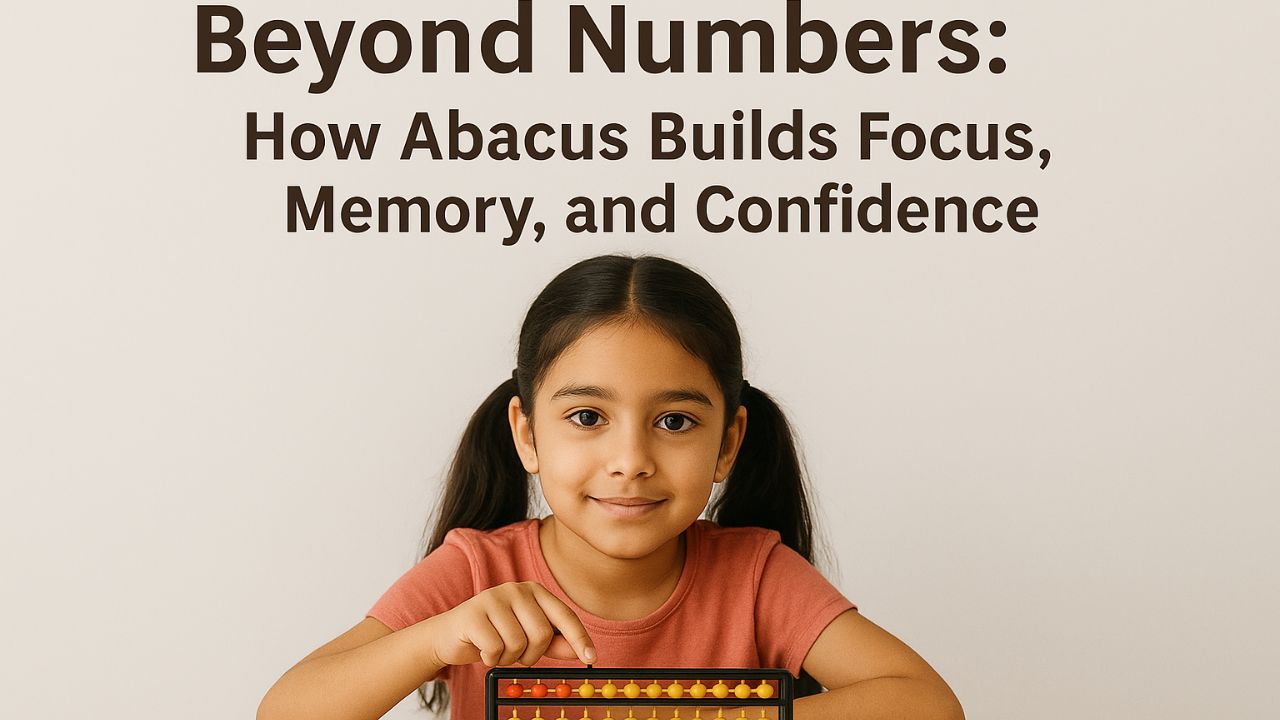
The Beads That Calmed Meera
When seven-year-old Meera first joined an abacus class in Pune, she was shy, easily distracted, and convinced she “just wasn’t a math person.” Six months later, her parents noticed a quiet transformation: Meera could sit through a 20-minute puzzle without fidgeting, recall long grocery lists, and—most surprising—she beamed when it was time for mental math races. The secret wasn’t only in arithmetic. It was in how abacus training reshaped her brain and mindset.
1. Abacus as a Brain Gym
At its simplest, the abacus is a frame of rods and beads. Children begin by physically moving beads to add and subtract. With practice they internalize the tool, imagining bead movements entirely in their minds—a technique known as mental abacus.
This dual stage—hands-on manipulation followed by vivid visualization—turns each lesson into a full cognitive workout. The process taps multiple areas of the brain at once:
- Visual-spatial centers to picture bead positions
- Motor regions to plan virtual finger movements
- Prefrontal cortex for concentration and working memory
2. Sharpening Focus and Attention
Why it works:
Abacus practice demands continuous attention. A single mental slip can derail an entire calculation, so children naturally train their ability to stay present.
Research highlight:
A 2020 study in Frontiers in Psychology found that primary-school students who practiced mental abacus for 12 months improved significantly on computerized attention tasks compared with control groups. The researchers noted stronger “sustained attention,” the same skill kids need to follow multi-step instructions or stay on task during homework.
Parent takeaway:
Short, regular sessions (5–10 minutes daily) are more effective for attention-building than occasional long classes.
3. Strengthening Working Memory
Working memory is the brain’s scratchpad—holding and manipulating information briefly. When a child mentally “sees” beads moving while adding or multiplying, they repeatedly store, update, and retrieve numbers.
Evidence from brain imaging:
- Tanaka et al. (2002, NeuroImage) observed heightened activity in both the parietal and frontal lobes of trained abacus users.
- Dong et al. (2016) reported that Chinese children with three years of abacus training outperformed peers on standard working-memory span tests, even after training stopped.
Better working memory spills over into reading comprehension, multi-step problem solving, and even remembering dance sequences or sports plays.
4. Building Unshakable Confidence
Abacus competitions—local, national, and international—offer children visible milestones. Completing complex calculations in seconds, often faster than a calculator, is an instant confidence booster.
But confidence isn’t only about speed. It comes from:
- Mastery experiences – children see measurable improvement week by week.
- Peer recognition – friendly competitions celebrate progress.
- Positive risk-taking – performing calculations publicly teaches poise under pressure.
Parents frequently report that shy children become more willing to speak up in class and tackle challenging subjects after a year of abacus practice.
5. Emotional Regulation and Calm
Interestingly, the rhythmic finger movements and steady counting can have a soothing, meditative effect. Some instructors liken it to “mindful math,” where children focus deeply and block out distractions, reducing anxiety.
6. Practical Tips for Parents
Choose a quality program
Seek certified instructors, small class sizes, and a clear progression from physical to mental abacus.
Encourage micro-practice
Five minutes after school or before dinner maintains momentum without overwhelm.
Celebrate effort, not just speed
Praise steady focus and improvement, not only winning competitions.
7. Real-Life Voices
- Arjun’s story, Bengaluru: After 18 months of abacus, Arjun’s teacher noted a dramatic jump in reading comprehension and fewer “careless mistakes.”
- Leah’s story, Singapore: Leah used her mental math edge to help classmates during group projects, boosting social confidence as well as grades.
These accounts, shared in parent forums and education features, echo findings from formal studies: the gains extend far beyond arithmetic.
8. Abacus as a Lifelong Asset
Children eventually move on from bead-based calculations, but the habits—focused attention, robust memory, and self-belief—stay for life. These are the same core skills employers value and adults rely on for everything from learning languages to managing complex projects.
Final Thoughts
The abacus may look like a simple wooden frame, but it acts like a multi-dimensional brain gym. For Meera and countless others, it’s less about quick sums and more about a mental transformation: sharper focus, stronger memory, and newfound confidence.
If you’re considering enrichment activities for your child, an abacus program isn’t just an investment in math—it’s an investment in the way your child thinks, remembers, and believes in themselves.
This article draws exclusively on publicly available research and education resources and is intended for informational purposes. Always evaluate individual programs to ensure they align with your child’s needs.